Caring for Your Parents From Afar: How to Build Real Peace of Mind Across the Miles
Many adult children no longer live in the same town as their parents. Sometimes it is a few hours' drive away, sometimes a whole border in between. Work, a partner, a family of their own have put down roots somewhere else. And yet the worry never quite leaves: how are Mum and Dad really doing when I can't drop by every day?
That distance can feel a lot like helplessness. But it doesn't have to. With a few smart routines and the right tools, you can stretch a reliable safety net across the miles.
The worries that come with distance
Anyone living far away knows the thoughts that creep in at night. Is someone there if something happens? Is she taking her medication? Has he been eating properly? Would I even find out in time if something were wrong?
The hard part about distance isn't only the lack of physical closeness. It's the fear of missing the changes that matter. A gradual decline, a new unsteadiness on the stairs, growing forgetfulness: from far away, these things are often noticed far too late.
The answer isn't to be constantly available or to keep your parents under surveillance. It lies in structure, a good network on the ground and the right technology.
1. Build a regular check-in ritual
Staying in regular contact is the single best early-warning system there is. If you have a quick call every day or every other day, you'll pick up on changes long before they turn into a crisis: a different tone of voice, confusion, exhaustion.
- A fixed time gives both sides something to rely on (the call after dinner, say)
- A video call shows far more than a phone call: how they look, how the home looks, their mood
- Bring the grandchildren in too. A short message or call keeps the connection warm
What matters most is the spirit of it. This is about caring, not controlling. A call that feels like an interrogation quickly becomes a burden.
2. Activate the network on the ground
You can't be there in five minutes, but other people can. A dependable local network is the backbone of caring from a distance.
- Neighbours are worth their weight in gold. Swap phone numbers and kindly ask them to get in touch if they notice anything off.
- The family doctor and pharmacist often understand the health picture better than the family does. A short line of contact, agreed to by your parents, can make an enormous difference when it counts.
- Home care and support services can drop in regularly, from help around the house to nursing care. What's available and how it's paid for varies a great deal from country to country, so ask locally about your options.
The more eyes and ears there are nearby, the less weight rests on you alone.
3. Keep the important information in one place
In an emergency, every minute counts, and that's no time to be hunting for phone numbers or a list of medications. Sit down with your parents and put together a simple overview:
- Contact details for the family doctor, close relatives and neighbours
- Current medications and any known conditions
- Where to find ID, the insurance card and important documents
Keep one copy somewhere visible at home (on the fridge, for instance) and another with you, so that everyone can act quickly when it matters.
4. Make the home safer, even from a distance
Many risks can be defused without being there all the time. On your next visit, or with a neighbour's help:
- Clear away trip hazards: loose rugs, trailing cables, poor lighting
- Fit grab rails in the bathroom and hallway
- Test the smoke alarms and install night lights
These small changes lower the risk noticeably, and they give you a calmer conscience.
5. Be ready for an emergency: stay reachable, fast
Even with the best precautions, something can always happen: a fall, a sudden dizzy spell. From a distance, the crucial question then becomes: how does help arrive quickly, and how do I find out about it?
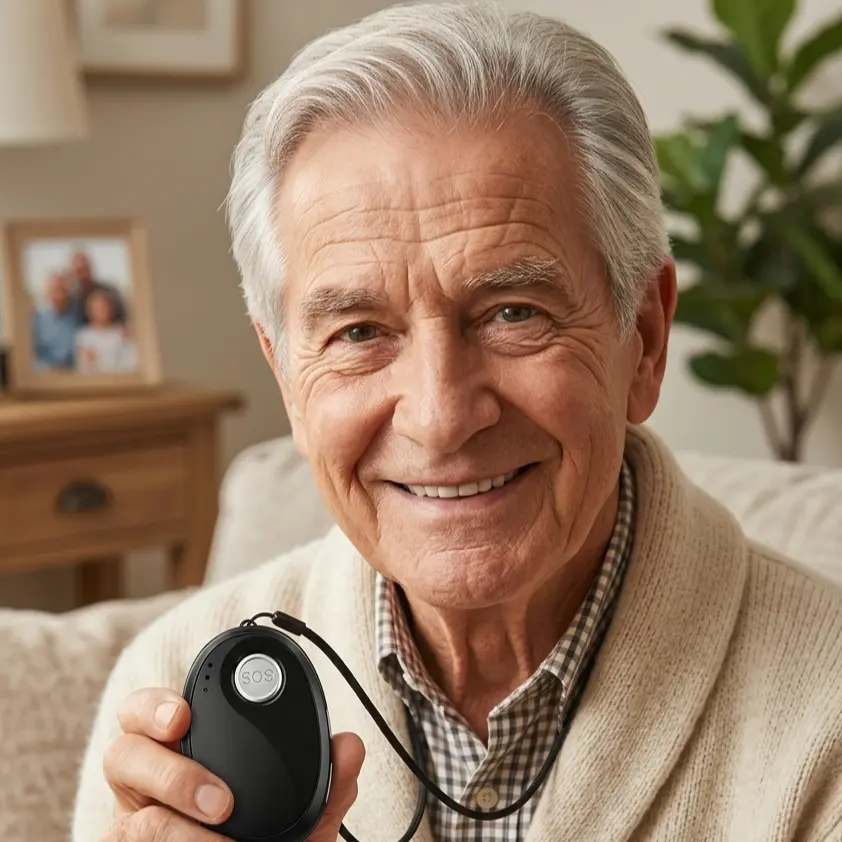
This is exactly where a mobile emergency button comes in. Devices like NOA connect at the press of a button first to the trusted contacts you've saved, meaning you and other people close to your parents. So in an emergency it's familiar voices that answer first, not strangers. As a backup, a 24/7 emergency call centre is always on standby in case no one in the family can be reached.
One feature is especially valuable when you're caring from afar: when an emergency call goes out, the GPS location is sent automatically. So you don't just learn that something has happened, but also where, whether in the garden, the park or out and about. Because the device uses its own mobile connection, it works anywhere there's network coverage, right across Europe.
That's how distance, which once felt like a risk, becomes manageable. Your parents keep their independence, and you know that in an emergency there's an instant line straight to you.
6. Don't forget yourself
Caring from a distance takes its toll: physically through the journeys, but above all emotionally. Many adult children struggle with guilt, the feeling of not being there enough, of not doing enough. Those feelings are understandable, but they don't help anyone.
- Share the responsibility with siblings and other relatives instead of carrying it all alone
- Accept that you can't control everything, and that this is okay
- Seek out others who are in the same situation and talk it through
You can only be a dependable source of support if you don't burn out yourself.
Conclusion
Caring for your parents from afar doesn't mean being everywhere at once. It means weaving a net: out of regular contact, a strong local network, well-organised information, a safer home, and a fast connection for emergencies.
Distance can't be erased. But it can be bridged. And it's often exactly this blend of closeness and technology that lets your parents go on living the life they want for as long as possible, on their own terms, in their own home.
Note: This article offers general guidance and is no substitute for individual medical, care-related or legal advice. Services and provisions differ from country to country, so please check with the relevant local authorities.