As the days get shorter, hallways, stairs and bathrooms spend far more hours poorly lit — and obstacles you spot too late are among the avoidable causes of falls at home. Good lighting does not mean as much light as possible; it means even, glare-free light on every route older people walk each day and at night.
Why does the home get riskier in the winter months?
The home itself does not change — the light does. In the European Union the clocks go back one hour on the last Sunday in October (as of 2026); after that, the afternoon is already dark for many people. Routes that were walked in daylight during the summer are now walked by artificial light or in half-darkness.
On top of that comes a change that is entirely normal with age: the eyes need more time to adjust when they move between bright and dark, and they need more light overall to pick out edges and contrasts reliably. Step out of a brightly lit living room into a dark hallway and you see almost nothing for a few seconds. Trips and stumbles happen in exactly those seconds.
There is a second effect that touches daily life as a whole. When it gets dark early, many older people go outside less often and spend more time indoors. The number of routes walked inside the home goes up — and with it the number of situations in which poor light becomes a problem.
What does good lighting mean in fall prevention?
Good lighting is, in the context of fall prevention, a set-up that illuminates every regularly used route in the home evenly, without glare and without dark stretches in between. What matters is not the wattage of a single lamp, but that there is no dark patch between two bright areas.
Three qualities make the difference:
- Evenness means a route has no abrupt jumps between very bright and very dark that the eyes have to adjust to first.
- Freedom from glare means no bare bulb shines straight into the field of view, and shiny floors do not throw the light back as a reflection.
- Reachability means every light switch can be reached before the dark stretch begins — not only at the far end of it.
A common mistake is the single strong ceiling light in the middle of the room. It casts hard shadows in exactly the places that matter: at door thresholds, at the first and last step of the stairs, and along the edges of furniture. Several smaller light sources are safer than one big one.
Which routes in the home need better light first?
Priority goes to the routes walked at night or in half-darkness, and to the places where the height changes. In almost every home, these are the same four areas.
- The route from the bed to the bathroom matters most, because it is walked regularly at night and only half awake.
- The stairs need light that can be switched both from the top and from the bottom, so that nobody sets off in the dark.
- The hallway needs light without dark stretches, because it connects all the other rooms and usually has no windows.
- The entrance area should be lit before the front door is opened, so that the threshold and anything left standing there are visible.
On the stairs, contrast is worth a second look: if every step is the same colour, they blur into one surface in weak light. A clearly visible edge on the first and last step helps more than a brighter lamp. Trip hazards room by room — rug edges, cables, door thresholds — go hand in hand with lighting and are worth a walk-through of their own.
How do you set up a night light for orientation?
A night light for orientation is a dim, glare-free light source that makes the night-time route visible without waking you up. It takes the place of the ceiling light, which is too bright at night and overwhelms the eyes for minutes. Setting it up usually takes less than an hour.
- Walk the night-time route from the bed to the bathroom once in the dark and note every spot where you hesitate or reach out for support.
- Put a dim light source near floor level at each of those spots, for example a plug-in light with a motion sensor or an LED strip under the edge of the bed.
- Choose warm, subdued light rather than bright, cold white light, so the eyes are not dazzled and sleep is disturbed less.
- Check that the light falls on the floor and does not shine at eye level — it is the route that has to be visible, not the lamp.
- Test the route at night again after the changes and improve the spots where a dark stretch still remains.
The order is what counts: watch the real route first, then add light. Buy first and look afterwards, and you often end up lighting places that were never a problem.
What helps if something happens despite good lighting?
Good lighting reduces the number of situations in which someone stumbles — it cannot rule out a fall. That is why every preparation for the dark season also includes the question of how quickly help can be reached if someone falls at home alone and cannot get up again.
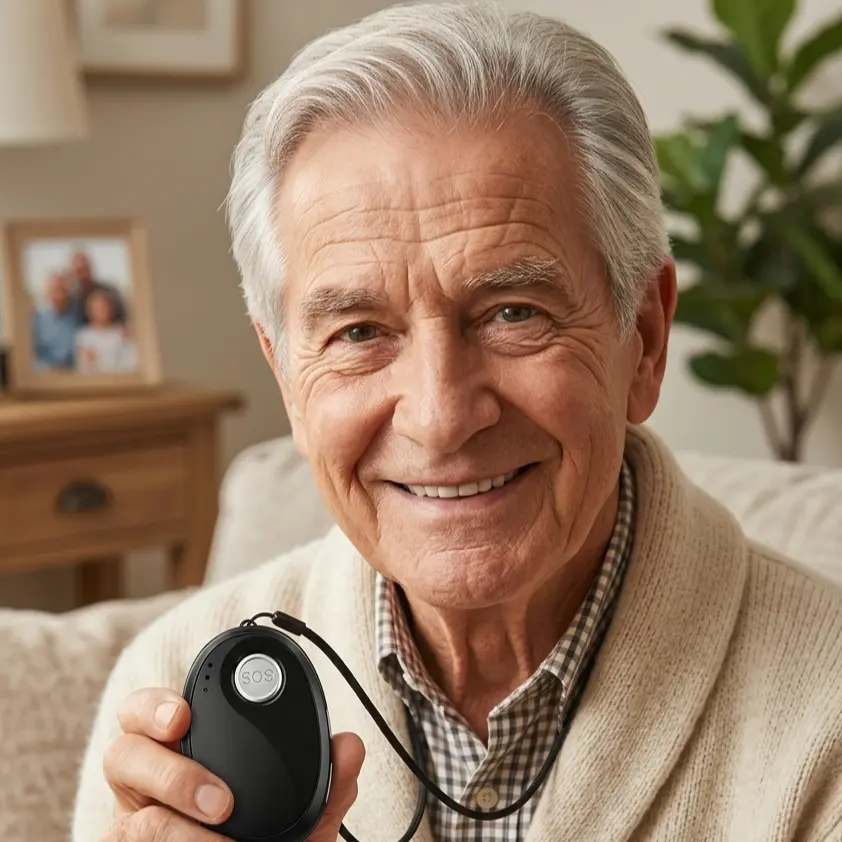
At NOA this path deliberately follows a fixed order: pressing the emergency button reaches the stored trusted contacts first — family, neighbours, close friends. These are the people who know the home, the state of health and the daily routine, and they can often be there fastest. If nobody in that chain responds, the emergency call centre, staffed around the clock, is brought in, takes over the case and alerts the emergency services if that is needed.
This chain does not replace care or medical treatment. It makes sure that hours do not pass between a fall and the first response. For relatives, that is the real difference in the winter months: they do not have to be constantly reachable themselves in order to know that someone is reachable.
Frequently asked questions
When should you change the lighting for the dark season?
September or early October is the best time, before the switch back on the last Sunday in October darkens the afternoons (as of 2026). Starting early means you can fit the new lights in daylight and walk the route calmly several times. Changes made in the middle of the dark season are more awkward and often stay half finished.
Is a motion sensor better than a light switch?
For the night-time route, usually yes, because nobody has to feel around for a switch in the dark. What matters is that the sensor triggers early enough and stays on long enough, so the light does not go out halfway along the route. In rooms where you sit quietly for longer, a normal switch remains the better choice.
Do you have to rewire the home for better light?
In most homes, no. Plug-in night lights with motion sensors, battery-powered LED strips with adhesive backing and extra floor or table lamps cover the critical spots without touching the fixed wiring. An electrician is only needed if switches are to be moved, new cables laid, or a stair light wired so it can be operated from both ends.
How do you persuade parents who resist the subject?
It helps to talk about convenience rather than the risk of falling: a light that comes on by itself at night saves fumbling for the switch. Many older people happily accept that kind of relief while they would turn down an explicit safety measure. Walking the route together, instead of making suggestions from outside, also meets far less resistance.
NOA is not a medical device and does not replace medical or nursing care. If there are health complaints, frequent dizziness or repeated falls, medical advice is the right next step.