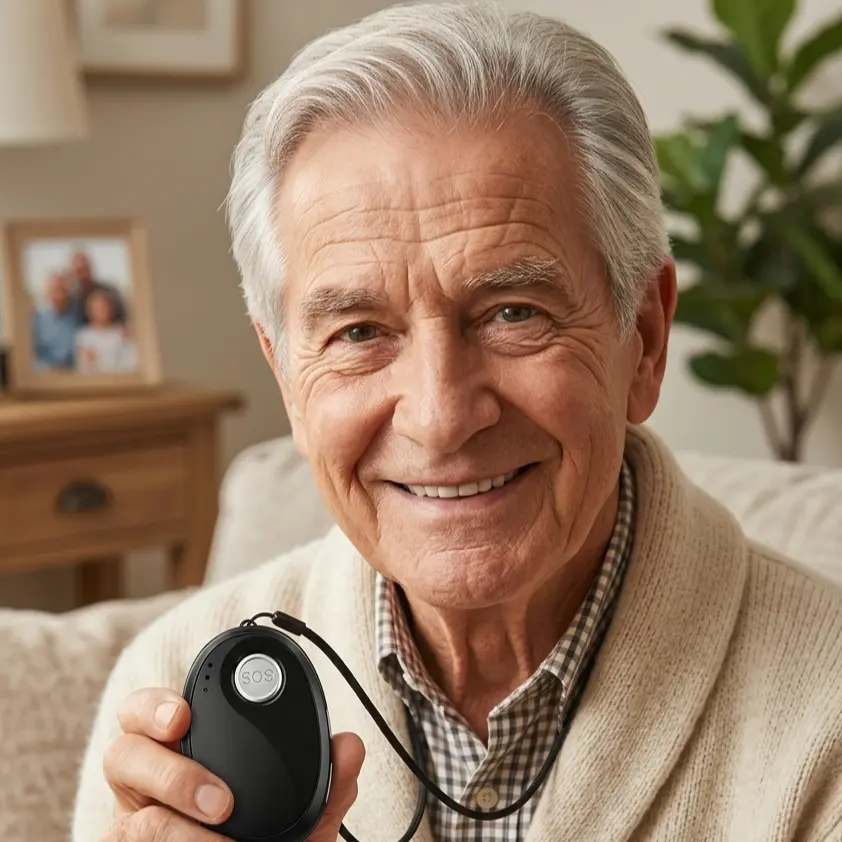
Older people avoid outdoor falls in autumn mainly through three things: shoes with a coarse, non-slip tread, walks in daylight rather than at dusk, and deliberately steering clear of wet leaves, moss and unlit stretches. A mobile emergency button additionally makes sure that someone can be reached quickly after a fall outdoors, because the alarm goes to family and trusted contacts straight away.
Why does the risk of falling outdoors rise as the days get shorter?
The risk of falling outdoors rises in autumn because three factors arrive at the same time: less daylight, more frequent wet surfaces, and ground conditions that change quickly. Wet leaves on a pavement are almost as slippery as ice, but far less obvious to the eye. Anyone walking at dusk spots kerbs, tree roots and uneven paving much later than in daylight.
There is also a change that comes with age: the human eye needs more time over the years to adjust to shifting light conditions. Moving from a lit street into a dark park path is therefore more demanding for older people than for younger ones.
- Wet leaves form a smooth film on asphalt and paving stones that sharply reduces the grip of a shoe sole.
- Moss and algae on shaded paths, steps and cellar stairs stay slippery even once the surroundings have dried out.
- Early darkness shortens the window in which walks, shopping trips and doctor's appointments are possible in good light.
- Rain and wind pull attention towards the umbrella and the hood instead of the ground ahead.
What does outdoor fall prevention mean?
Outdoor fall prevention is the sum of all measures that make a fall on paths away from home less likely and that limit the consequences if a fall does happen. Outdoor fall prevention covers three levels: the physical steadiness of the person walking, the equipment carried along the way, and the question of how quickly help can be reached after a fall.
The difference from fall prevention inside the home matters a great deal. Inside a home, rugs can be removed, cables rerouted and grab rails fitted, because the environment can be changed. Outdoors, the pavement is simply what it is. Anyone who wants to be safer outdoors therefore changes the equipment, the route planning and the ability to reach someone in an emergency, rather than the environment.
Which shoes and equipment make autumn walks safer?
Autumn walks become safer above all through shoes with a grippy treaded sole, a firm hold at the heel and a flat profile. Bright, clearly visible clothing and a personal light source that illuminates the ground ahead complete the picture. These measures work immediately and cost very little.
- Shoes with a coarse tread and a firm heel counter give far more hold on wet leaves than smooth leather soles or slippers with an open heel.
- A small torch or a head torch lights up the ground, whereas street lamps mainly light the road.
- Reflective strips on a jacket, a bag or a walking stick make older people visible to drivers and cyclists earlier.
- A walking stick with an intact rubber tip grips on wet ground, while a worn-down tip slides away.
- A rucksack instead of a handbag leaves both hands free, so a handrail or railing can be grabbed when needed.
How can an autumn walk be planned safely?
An autumn walk becomes safer when it is thought through briefly before setting off: the time of day, the route and the way back. The most important decision is the time of day, because a trip that starts in daylight and ends in daylight is considerably safer than the same trip two hours later.
- Put errands in the bright middle of the day rather than the late afternoon, because autumn evenings grow dark noticeably earlier.
- Choose lit and properly surfaced paths, even when the detour adds a few minutes.
- Check the weather forecast before setting off, because wet paths and strong wind place different demands on footwear and walking pace.
- Tell someone you trust where you are going and roughly when you plan to be back.
- Carry the mobile phone and the emergency button on your body, not in a bag that can drop out of your hand during a fall.
What helps if something does happen outdoors?
If something happens outdoors, what counts most is how quickly someone learns where the person who fell is lying. A fall in the living room is often noticed by a visitor or by a care worker. A fall on a farm track at the edge of the village may go unnoticed for hours, which is particularly dangerous in cold and wet weather.
This is exactly where a mobile emergency button differs from a classic home emergency call system. A home emergency call system works inside the home. A mobile emergency button is worn on the body and also works in the places where older people actually fall in autumn: on the way to the bakery, in the garden, at the cemetery or at the bus stop.
With NOA, the alarm goes first to the family and to the trusted contacts stored in the system. That order is deliberate: in many cases a daughter, a son or a neighbour is on the scene faster than any call centre and also knows what the person concerned needs. If nobody from that circle responds, the 24/7 emergency call centre steps in as backup and takes the next steps. Both levels belong together, with the family first and the emergency call centre as a dependable second line.
Frequently asked questions
At what point should older people stop walking outdoors alone in autumn?
There is no fixed age limit. What matters is whether the walk is managed safely: anyone who feels unsteady, trips more often or is exhausted after a short distance should choose shorter routes or look for company. Walking remains important, because movement strengthens muscles and balance and lowers the risk of falling over the long term.
Do walking sticks or Nordic walking poles help against falls in autumn?
Sticks and poles widen the base of support and give extra hold on uneven or slippery ground. Intact rubber tips and a suitable length are essential. Anyone who has never used sticks or poles before should practise on level, dry ground first, because poorly handled sticks can become a tripping hazard themselves.
Does a mobile emergency button work outside towns and villages?
A mobile emergency button needs mobile network reception. In inhabited parts of Europe, coverage is usually good, while deep valleys, dense forests and some rural regions can have gaps. For routes used regularly, it is worth testing reception once in a calm moment rather than relying on it in an emergency.
What can be done when an older relative rejects every precaution?
Pressure usually creates resistance. It helps more to start with a small, uncontroversial step, such as new shoes with a proper tread, and to talk about the concrete benefit rather than about age. Many older people accept safety technology more easily when it is described as a way of staying independent.
NOA is not a medical device and does not replace medical or nursing care. In cases of frequent falls, dizziness or persistent unsteadiness while walking, please consult a medical professional.