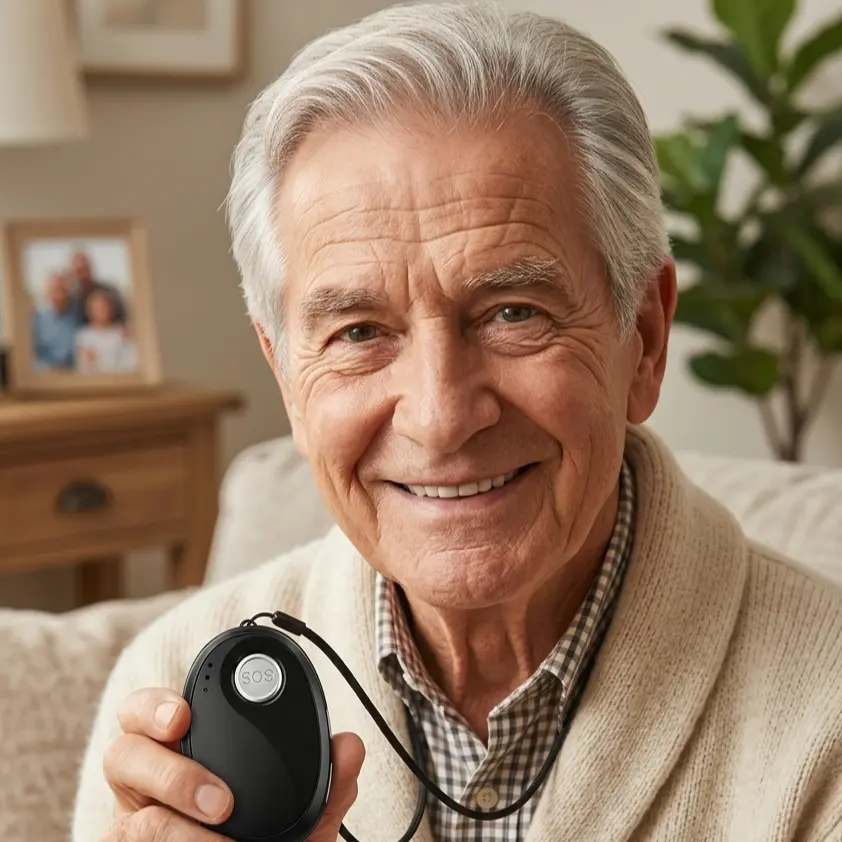
Automatic fall detection is a feature in which motion sensors inside the emergency call device detect a fall themselves and trigger an alarm, even when the person can no longer press the button. It picks up hard falls more reliably than a slow sink to the floor, and it does not replace the manual emergency button. It makes sense as an extra safeguard, not as a stand-alone safety solution.
How does automatic fall detection work technically?
Automatic fall detection relies on motion sensors built into the emergency call device, which continuously measure the position and the acceleration of the device. When the software recognises the typical pattern of a fall, a rapid downward movement, a hard impact and unusual stillness afterwards, the device raises an alarm on its own. The person wearing it does not have to do anything.
The components involved are similar in almost all modern devices:
- An acceleration sensor measures how fast the device is moving and in which direction.
- A position sensor registers whether the device is being worn upright or is lying flat.
- Evaluation software compares these readings with stored fall patterns and decides whether an alarm is justified.
What matters is not the individual sensor but the evaluation. A device that only watches for the impact will report every hard knock. A device that also assesses the stillness that follows can tell a real fall from a button that has simply been put down far more accurately.
Which falls are reliably detected and which are not?
Hard falls from standing or walking are detected most reliably, because they produce a clear sensor pattern. Falls without a distinct impact are harder: sliding slowly down a wall or tipping out of a chair produces readings that barely differ from normal movement. No system detects every fall.
Usually recognised well:
- Falls while walking or standing with a hard impact on a solid floor.
- Falls on stairs, because several strong movement impulses occur in quick succession.
- Falls after which the person stays motionless on the ground for a longer period.
Harder to recognise:
- Sinking slowly to the floor, for example during a circulatory weakness.
- Falls onto soft surfaces such as carpet, a bed or a lawn.
- Falls in which the person can still break the movement and gets straight back up.
These limits are not the shortcoming of one particular manufacturer, they are a property of the measuring method itself. Knowing them lets you set up your own safeguards realistically.
Why do false alarms happen and how do you handle them?
False alarms occur when an everyday movement resembles the sensor pattern of a fall. Typical causes are a dropped device, sitting down heavily, or placing the emergency button on a hard table top. Many devices absorb this by not alerting anyone straight away: they first give an audible signal and allow a short window in which the alarm can be cancelled.
This is how to deal with a false alarm sensibly:
- Cancel an accidentally triggered alarm on the device immediately, while the cancellation window is still running.
- Give your trusted contacts a quick all-clear if the message has already gone out.
- Think about the situation in which the false alarm arose and put the device down more gently in future.
- If false alarms keep occurring during the same everyday routine, ask your provider about the sensitivity setting.
The occasional false alarm is the price of sensitive detection. It weighs far less than a fall that goes unnoticed. What matters is that your trusted contacts understand this difference and do not panic at every message.
What happens when an alarm is triggered automatically at NOA?
At NOA, an automatically detected fall triggers the same alarm chain as a manually pressed emergency button. The trusted contacts you have stored are notified first: family, neighbours or friends who can be there quickly. If nobody from that circle responds, the 24/7 emergency call centre is brought in as backup.
The sequence at a glance:
- The emergency call device recognises a fall pattern and gives an audible signal with a short chance to cancel.
- If it is not cancelled, the alarm goes to the first trusted contact on the list.
- If there is no response, the chain moves on to the next person on the list.
- If nobody from the personal circle answers, the 24/7 emergency call centre takes over.
This order is deliberate: in most cases a familiar person from your own surroundings is the fastest and the most pleasant help. The emergency call centre is the backup when that route does not work, and it is not a substitute for the emergency services.
How do you set up automatic fall detection sensibly?
Automatic fall detection only works if the emergency call device is actually worn on the body and the emergency chain is kept up to date. An emergency button in a drawer detects no falls, and an alarm chain with outdated phone numbers leads nowhere. Checking both takes a few minutes and decides how effective the system is.
Go through these points once, deliberately:
- Wear the emergency call device where the manufacturer intends it to sit, so that the sensors can measure your body movement.
- Store at least two trusted contacts, so the alarm chain does not depend on a single person.
- Check the stored phone numbers regularly, for example at every turn of the year.
- Test the manual emergency call in a quiet moment, so the procedure feels familiar when it matters.
- Talk to your trusted contacts about what exactly they should do when a message arrives.
Automatic fall detection is an additional layer of safety for the case where the button is out of reach. A deliberately pressed emergency call remains the fastest and most reliable way to get help.
Frequently asked questions
Does automatic fall detection replace the emergency button?
No. Automatic fall detection is an addition for situations in which someone can no longer press the button. Because no sensor system detects every fall, a deliberately triggered emergency call remains the most reliable route. Anyone who is conscious and needs help should always press the button rather than wait for the detection to react.
Does fall detection also work outside the home?
Yes. The sensors work regardless of location, because they only measure the movement of the device. For the alarm that follows, however, the device needs mobile network coverage. In areas without a signal, a detected fall cannot be reported, and that applies to every mobile emergency call device, whichever provider it comes from.
What happens if I can get up again after a detected fall?
The device announces the alarm with a signal and allows a short window in which you can cancel it. If you cancel within that time, nobody is notified. If the message has already gone out, get in touch briefly with the person who received it and let them know that you are all right.
Does the emergency call device have to be worn on the body?
Yes. Fall detection measures the movement of the device, not the movement of the person. If the emergency button is lying in a bag, on the table or in the bedside cabinet, it will not register that the wearer has fallen. The device should therefore be worn exactly as the manufacturer specifies.
Can I adjust the sensitivity myself?
That depends on the device. Some systems offer several sensitivity levels, others work with a fixed setting. If false alarms keep occurring in the same everyday situation, that is a good reason to ask your provider. As of 2026, a freely selectable sensitivity is not available on every device.
NOA is not a medical device and does not replace medical or nursing care. If you have acute health problems, please seek medical help or call the European emergency number 112.