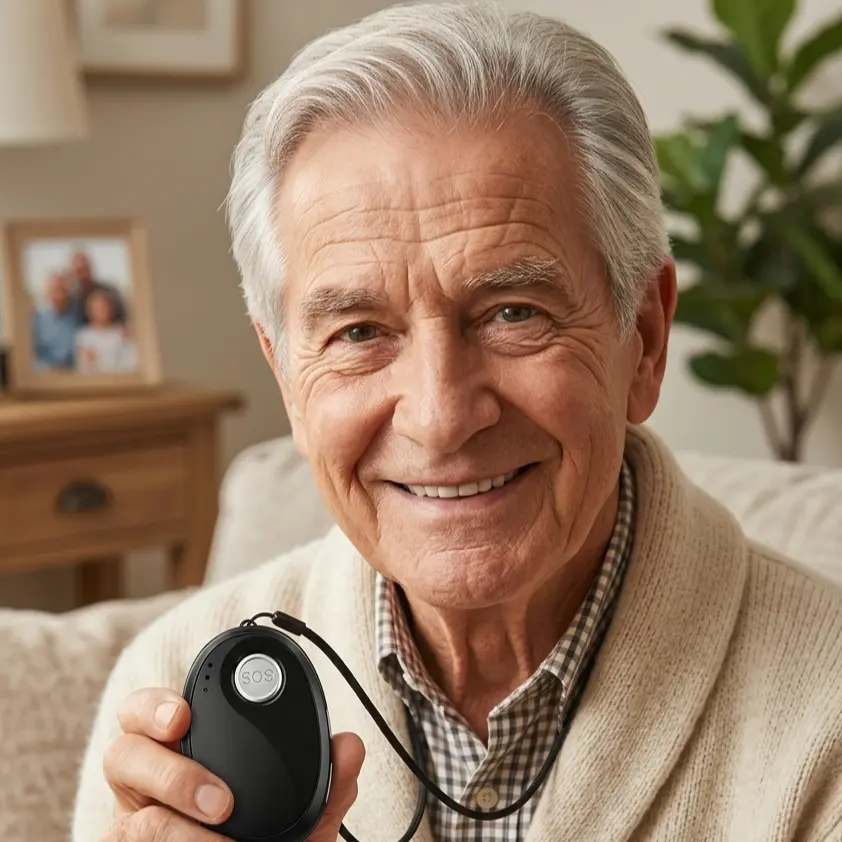
With an emergency button that has location tracking, the only people who see the location are the ones the person wearing the device has named: usually family members and the emergency call centre. With NOA, the location is transmitted by default only when the emergency key is pressed. Continuous tracking is possible only after explicit consent, which can be withdrawn at any time.
What does location tracking mean with an emergency button?
Location tracking is the technical process of determining a device's current position so that help reaches the right place. A mobile emergency button works out that position from satellite signals (GPS) and, in addition, from the mobile phone network. A mobile emergency button is therefore not an everyday tracking beacon, but a device that answers one single question when things get serious: where is the person right now?
The difference between a mobile emergency button and a classic home emergency call system lies exactly in this link to a place. A home emergency call system only ever knows one address, namely the flat. A mobile emergency button also works at the garden gate, in the supermarket or on the way to the doctor. This freedom of movement is the real purpose of location tracking.
The accuracy of location tracking is not the same everywhere. Out in the open, a GPS position is usually accurate to within a few metres. Inside buildings, in narrow courtyards or in underground car parks, the satellite signal becomes weaker and the position that is determined becomes less precise. Location tracking therefore never replaces the conversation: anyone who is able to speak can say on the phone where they are.
Who can actually see the location?
The location is visible to one clearly named, small circle only: the trusted contacts that the person wearing the device has entered into their own emergency chain, and the emergency call centre in the event of an alarm. There is no public map, no access for neighbours and no trade in movement data.
With NOA, the order is deliberate: family members and trusted contacts are reached first, and the 24/7 emergency call centre stands behind them as the backup in case nobody in the family responds. The location therefore travels along the same chain as the emergency call itself and is not spread more widely than the help.
Who appears in this emergency chain is decided by the person wearing the device. Names can be added and removed again. This is exactly the point that reassures many older people: location tracking is not a one-way street towards control, but a list that the wearer keeps themselves.
When is the location transmitted, only in an emergency or continuously?
In standard operation, the NOA device transmits the location only when the emergency key is pressed. Between two alarms, no movement profile is created. Anyone who wears the emergency button and does not press it is not being followed.
Beyond that, there are functions that some families explicitly ask for: a live location display, safe zones with a notification when they are left, inactivity monitoring, or a stored location history. These additional functions are not preset with NOA. They only take effect once the person wearing the device gives written consent.
The separation between emergency location tracking and continuous location tracking matters, because both situations have their justification:
- For most people, location tracking in an emergency is entirely sufficient, because the emergency button is only meant to reveal something about a whereabouts when things get serious.
- In early-stage dementia, by contrast, continuous location tracking can be the very reason why a person is still able to go for a walk alone.
- Between the two options there is always a conscious decision, never a default setting that nobody noticed.
What rights does the person wearing the device have?
Location data is personal data. In the European Union and in the European Economic Area, the General Data Protection Regulation applies to it (as of 2026). Among other things, the regulation gives the person concerned the right to request information about the data stored about them, and the right to withdraw consent that has been given at any time with effect for the future.
For an emergency button with location tracking, that means three very concrete things. First, continuous location tracking has to be voluntary, because nobody may switch it on quietly. Second, it must be clear which people are allowed to view the location data. Third, withdrawing consent must be just as easy as giving it.
For continuous location tracking, NOA therefore works with a written consent form. On that form, the person wearing the device enters which tracking functions are permitted and which people may view the location. If someone is no longer able to give valid consent themselves, the legal representative signs and encloses proof of the authority to represent.
How can location tracking be discussed without sounding like surveillance?
The conversation works best when location tracking is described as a tool for freedom rather than as an instrument of control. The sentence This lets me see where you are creates resistance. The sentence This lets the ambulance service find you when you can no longer say where you are describes the same technology and captures its true purpose.
For this conversation, the following order has proved itself in many families:
- First clarify which problem is to be solved, because a fall in the garden is something different from wandering off at night with dementia.
- Start with the smallest sufficient level, that is, location tracking in an emergency only.
- Decide together which people are allowed to see the location, and write those names down.
- Agree on a date for reviewing the setting again, for example after six months or after a stay in hospital.
- Promise explicitly that consent can be taken back at any time without the emergency button becoming useless as a result.
The last point is the most important one. An emergency button loses its effect if it is worn in secret or constantly causes friction. A device whose settings the person wearing it knows and has helped to shape is used far more reliably.
Frequently asked questions
Can my family see where I am at any time?
No, not unless continuous location tracking has been switched on explicitly. In standard operation, the NOA device sends the location only when an emergency call is triggered. A live location display for relatives is an additional function that requires written consent from the person wearing the device, and that consent can be switched off again at any time.
How accurate is the location tracking of a mobile emergency button?
Out in the open, a GPS position is usually accurate to within a few metres. Inside buildings, in cellars or in underground car parks, the satellite signal becomes weaker and the position that is determined can become considerably less precise. Talking to the emergency call centre therefore remains important, because a spoken description of a place is often more precise than any coordinate.
What happens to the location data after an emergency call?
The location transmitted during an alarm serves to bring help to the right place and is processed as part of the alarm documentation. In the European Union and in the European Economic Area, the people concerned have the right to request information about the data stored about them. If in doubt, ask the provider directly how long the data is kept.
Can I take back consent once it has been given?
Yes. Consent to continuous location tracking is voluntary and can be withdrawn at any time with effect for the future. The emergency button keeps working afterwards and simply falls back to standard operation, in which the location is transmitted only in an alarm. Withdrawing consent therefore switches off the additional function, not the safety.
NOA is not a medical device and does not replace medical or nursing care.