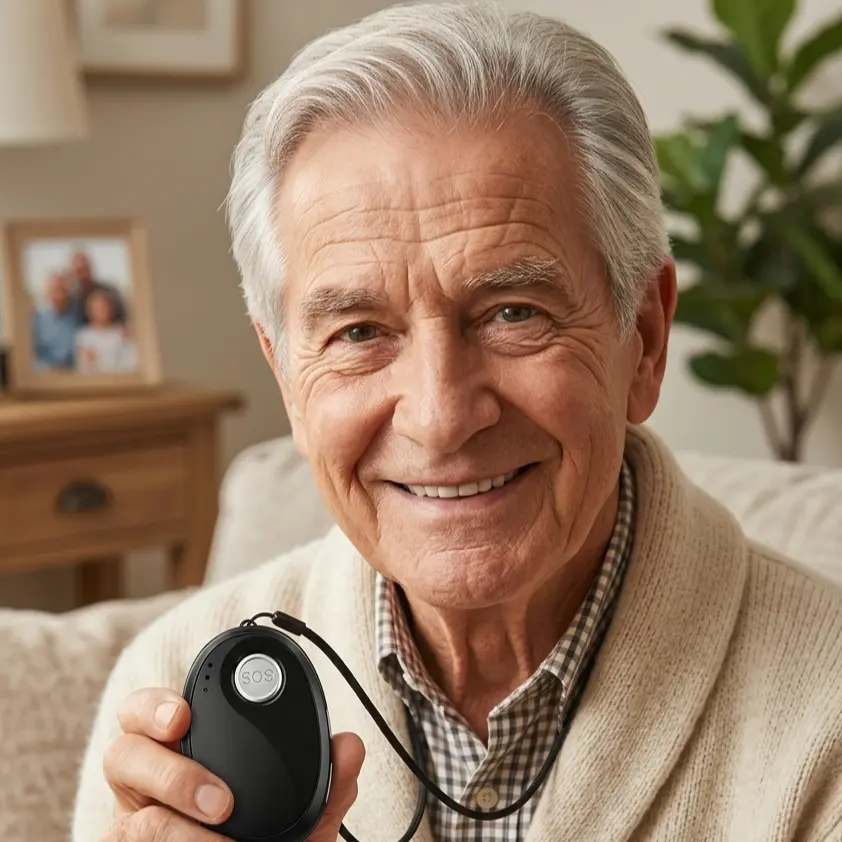
In a life-threatening situation, dial 112, the single European emergency number that connects you to an emergency control centre. A mobile emergency button such as NOA helps when someone needs support and wants to reach trusted contacts at the press of a button. The NOA device cannot place an emergency call to 112, but alerts trusted contacts and, on the NOA Mini, a 24/7 emergency call centre if switched on.
What is the emergency number 112?
112 is the single European emergency number: it can be dialled free of charge in every member state of the European Union, including from a mobile phone, and leads to an emergency control centre. The control centre can dispatch the ambulance service, the fire brigade or the police.
Many countries have other national emergency numbers in addition to 112. In the countries of the European Union, 112 works alongside these numbers, and 112 can also be reached in many other European countries. Anyone who wants to remember just one emergency number for the whole of Europe should remember 112.
When you call 112, the control centre will usually first ask where the emergency is and what has happened. It therefore helps to be able to give your own address calmly and in full, and to stay on the line until the control centre ends the call.
What is a mobile emergency button – and what is it not?
A mobile emergency button is a small portable device that, at the press of a button, alerts people chosen in advance and transmits the location. A mobile emergency button is not a public emergency control centre and does not replace 112.
At the press of a button, the NOA Mini notifies the chosen trusted contacts and, if switched on, a private 24/7 emergency call centre. The NOA Mini transmits the device location and allows a conversation through the device (as of 2026).
The NOA device cannot place an emergency call to 112. After an alarm, the trusted contacts or the 24/7 emergency call centre can call the ambulance service if the situation requires it.
When is 112 the right choice?
112 is the right choice as soon as there could be a danger to life or a serious injury is possible. In such situations, what matters is that the emergency control centre is informed without detours. If the person affected cannot make the call themselves, someone who is present should dial 112.
Typical situations for 112 include, for example:
- A person is unconscious or no longer responds properly when spoken to.
- A person has severe shortness of breath or sudden severe chest pain.
- A person suddenly shows paralysis, speech difficulties or a drooping corner of the mouth.
- After a fall, a person is in severe pain, is bleeding heavily or cannot move.
- There is a fire in the home, or there is a clear smell of gas or smoke.
Anyone who is unsure whether a situation is life-threatening should dial 112 if in doubt. The emergency control centre then decides together with the caller what help is needed.
When does the mobile emergency button help?
The mobile emergency button helps when someone needs support but cannot reach the phone, or would like to inform a familiar person first. Typical examples are situations with no apparent danger to life in which it is still important that someone finds out quickly.
Examples of such situations are:
- A person has fallen, is responsive and uninjured, but cannot get up again alone.
- A person feels unsafe while out and about and wants their relatives to know where they are.
- A person needs help at home but cannot reach the phone.
- A person notices something unusual in the home and wants to speak to a trusted contact.
With the NOA Mini, after the button is pressed the device calls the stored trusted contacts one after another and sends the GPS location to the message recipients. If the emergency call service is switched on and nobody answers beforehand, NOA calls the 24/7 emergency call centre. The emergency call centre speaks to the person and arranges help if needed.
What should you do if it is unclear how serious the situation is?
If it is unclear how serious a situation is, 112 takes priority as long as a danger to life cannot be ruled out. The mobile emergency button complements 112 by informing the family and the trusted contacts. The two routes do not exclude each other.
A proven sequence for unclear situations looks like this:
- If a danger to life cannot be ruled out, the person affected or someone who is present dials 112 first.
- If the person affected cannot make a call themselves, they press the emergency button so that the trusted contacts are alerted and can call the ambulance service.
- As soon as the situation allows, the relatives are informed so that someone can check on the person affected or accompany them to hospital.
For relatives, an alarm from the mobile emergency button is a signal to act. If the situation sounds life-threatening on the phone, the relatives call 112 themselves and give the transmitted location.
How do family and trusted contacts prepare?
Family and trusted contacts prepare best by agreeing the rules for an emergency together in advance. A mobile emergency button only works as well as the people who can be reached during an alarm and know what to do.
Family and trusted contacts should clarify these points together:
- Everyone involved discusses in which situations 112 is dialled and in which the emergency button is used.
- The trusted contacts know that they call 112 themselves during an alarm if the situation seems life-threatening.
- The trusted contacts switch off their voicemail for calls from NOA, because with the NOA Mini, if a voicemail picks up, the call counts as answered and the call chain ends.
- The mobile emergency button is charged regularly, because no alarm can be transmitted without a charged battery or without mobile network reception.
- Important information such as a medication list and contact details is kept close at hand, for example in an emergency folder.
Anyone who wants to go further will find more guides in the NOA magazine on setting up emergency contacts correctly, the emergency folder for seniors and what happens when the emergency button is pressed.
Frequently asked questions
Can I call 112 with the NOA device?
No. The NOA device cannot place an emergency call to 112. NOA alerts the trusted contacts and, on the NOA Mini, the 24/7 emergency call centre if switched on; the trusted contacts or the emergency call centre can call the ambulance service. In a life-threatening situation, the person affected should dial 112 themselves if possible, or ask someone present to do so.
Is the 24/7 emergency call centre the same as 112?
No. The 24/7 emergency call centre for the NOA Mini is a private emergency call centre and not a public emergency control centre. The emergency call centre is only called if the emergency call service is switched on for the device and nobody from the circle of trusted contacts answers beforehand. The emergency call centre then speaks to the person and arranges help if needed.
Does 112 also work on holiday abroad?
Yes. Within the European Union, 112 can be dialled free of charge in every member state, including from a mobile phone. 112 can also be reached in many other European countries. Anyone travelling should remember 112 as the common European emergency number and, before the trip, also check which national emergency numbers apply in the destination country.
Is an emergency button worthwhile if you can also dial 112?
112 and a mobile emergency button serve different purposes. 112 is there for life-threatening emergencies and requires someone to be able to make a phone call. A mobile emergency button such as NOA helps in situations where the phone is out of reach or the family should know first, and it transmits the location.
NOA is not a medical device and does not replace the emergency number 112, nor medical, nursing or ambulance services. In a life-threatening situation, dial 112 yourself if possible.