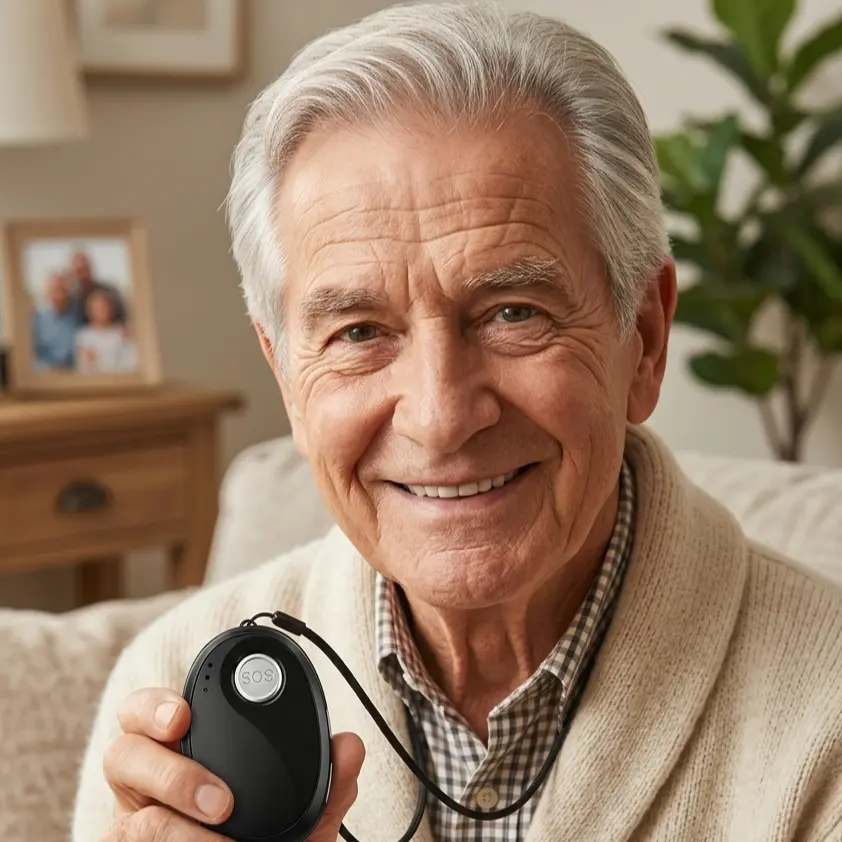
When a mobile emergency button is pressed, the device raises an alarm straight away: it determines the current location and calls the stored trusted contacts one after another until someone answers. If nobody answers, the device calls an emergency call centre staffed around the clock as the last link — provided the emergency call service is switched on for the device. The person wearing the device only has to wait.
What is a mobile emergency button?
A mobile emergency button is a small device worn on the body with its own mobile network connection that sends an emergency call to previously chosen people at the press of a button. Unlike a classic home emergency system, a mobile emergency button is not tied to a base station inside the home and therefore works out and about as well.
The difference between a mobile emergency button and a telephone lies in how it is used. There is no number to dial and no display to unlock. A single button starts the whole sequence, even when the person concerned can no longer get up after a fall or speak clearly.
- The device is worn directly on the body as a pendant, a wristband or a watch.
- The connection runs over the mobile network and not over a fixed telephone line in the home.
- Which contacts are called in an emergency is agreed in advance by the family members together.
What happens in the first seconds after the button is pressed?
In the first seconds the device confirms the alarm and starts two processes at the same time: the device determines the current location and builds the connection to the mobile network. The person wearing the device notices this through a feedback signal — depending on the model a sound, a vibration or a flashing light.
That feedback signal matters more than it sounds. The signal tells the person wearing the device: the alarm has gone out, someone is taking care of it, nothing else needs to be done. Anyone lying alone on the floor after a fall gains the calm to stay put instead of risking a dangerous attempt to stand up.
In carefully designed systems the location is transmitted only in an alarm situation. Continuous monitoring does not take place — pressing the emergency button is the deliberate decision to release one's own location for this one emergency.
Who is alerted — and in what order?
The first people alerted are those stored beforehand as trusted contacts, usually family members, neighbours or close friends. The system works through this list from top to bottom and calls the next person only once the previous person cannot be reached.
That order is a deliberate decision. In a real emergency a familiar voice is often worth more than a stranger's: a son who lives ten minutes away is on the spot faster than any outside service, and the son knows where the door key is kept. At NOA the rule is therefore family and trusted contacts first, with the 24/7 emergency call centre as the backup behind them.
- The first trusted contact is called and also receives a message containing the location.
- If that trusted contact does not pick up, the call automatically goes to the next person on the list.
- If nobody from the private circle picks up, the device calls the emergency call centre, provided the emergency call service is switched on.
For the family members one point is decisive: an alarm is not settled by the fact that a call was answered. An alarm is settled only once somebody has actually looked in on the person wearing the device.
What happens if nobody in the family answers?
If the emergency call service is switched on for this device and nobody in the private emergency chain answers, the device calls an emergency call centre staffed around the clock as the last link. Trained staff there take over the case, see the transmitted location and alert the ambulance service if that is needed.
The emergency call centre is the backup behind the family and not a replacement for the family. The emergency call centre steps in precisely in those situations where the private contacts happen to be at the cinema, asleep or out of reception — the situations in which a purely private chain would otherwise run into the void.
Many families overlook one special case: if the voicemail of a trusted contact picks up, the call counts as answered in technical terms and the device stops dialling onwards. The emergency call centre at the end of the chain is then no longer called: the call only reaches it if nobody earlier in the chain picks up. Anyone who uses voicemail should keep this point in mind when setting up the emergency chain.
What happens in the event of a false alarm?
An emergency call triggered by accident is no disaster and should not be treated as one. Anyone who presses the emergency button by mistake simply takes the return call and says that everything is fine. That ends the whole process.
It only becomes a problem when fear of a false alarm means the emergency button is never pressed at all. That hesitation is one of the most common reasons why emergency buttons stay silent when they are really needed. Families should therefore make clear from the very start that a false alarm is a good sign: a false alarm proves that the device works and that the threshold for using it is low enough.
How do families best practise the sequence?
Families do best to run through the whole sequence once before it is needed — with an announced test alarm at a time of day when everyone involved is near a phone. That way every trusted contact sees once how the call arrives and what the location message looks like.
- Agree the test date together and let all stored contacts know about it.
- Let the person who wears the device press the button, rather than a family member.
- Check that every trusted contact has saved the number of the device in their phone, otherwise the alarm shows up as an unknown call.
- Repeat the test about twice a year, for example whenever the clocks change.
Frequently asked questions
Does the emergency button also work elsewhere in Europe?
Yes. A mobile emergency button with its own SIM card works anywhere the device has access to a mobile network, which covers all of Europe. The alarm goes to the same trusted contacts as at home; only the transmitted location is different. Anyone travelling should check in advance whether the device has reception at the destination.
What happens if the location cannot be determined?
The emergency call still goes out. Without a satellite signal, for example in a cellar or a solid old building, many devices fall back on the mobile phone cell. The location is then less precise, but it still points to a street or a neighbourhood. The chain of calls to the trusted contacts runs entirely independently of this.
Can family members see whether somebody else has already taken over?
Not with NOA: the trusted contacts learn about the alarm and the location, but not who answered the call. A short message in the family group chat makes clear who is on the way. That prevents three adult children from setting off at the same time or, worse, each of them assuming that one of the others is already taking care of it.
Does the emergency button replace calling 112?
No. Across the European Union, 112 is the free number for the ambulance service, the fire brigade and the police, and it remains the direct route whenever there is an acute threat to life. The mobile emergency button is the answer for the moment when the telephone is out of reach or dialling a number is no longer possible.
Note: NOA is not a medical device and does not replace medical or nursing care. For health-related questions, please speak to your doctor.