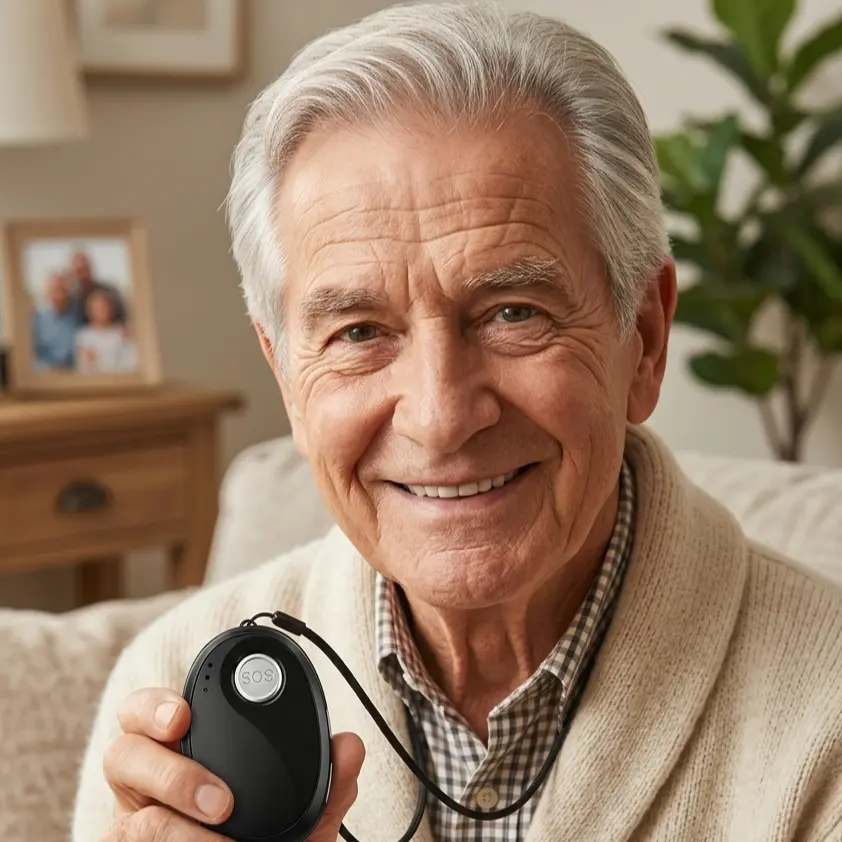
Setting Up Emergency Contacts: Who Belongs in Your Emergency Chain?
An emergency button is only as good as the people it reaches in a crisis. If no one picks up the phone at the crucial moment, no one gets help, no matter how reliably the technology works. That's why it pays to sit down and think through your emergency chain properly: Who gets called first? Who steps in if that person happens to be unreachable? And what happens if no one from your personal circle answers the phone?
This guide shows what a well-thought-out emergency chain looks like, whatever device or provider you happen to use.
What Is an Emergency Chain?
An emergency chain is the order in which an emergency system tries to reach people when an alarm is triggered. When the wearer sets off an alarm, the device doesn't dial every saved number at once. Instead, it works through a set list: first the first person, then, if they don't answer, the second, then the third, and so on.
The idea behind it is simple: someone should always be reachable. A single phone number isn't enough for that. People are in meetings, in tunnels, asleep, or simply nowhere near their phone. It's only when you line up several contacts one after another that the chain becomes dependable.
Family and Trusted People First
Here's the big advantage of a modern mobile emergency button: in a real emergency, the first voice on the line is a familiar one, a daughter, a neighbour, a close friend. People who know the person affected can often tell from their tone of voice what's going on. They know the home, the medical history, where the spare key is kept. And for an older person, hearing a familiar voice in a moment of panic is far more reassuring than reaching a stranger at a call centre.
So the rule of thumb is this: the start of the chain belongs to the people who can react quickly and, if needed, come round in person.
Good candidates for the top spots are:
- Relatives who live nearby — children, grandchildren or siblings who can be there within a short time
- Neighbours you're on good terms with — they're often the fastest to arrive
- Close friends who are easy to reach during the day
Why a Single Contact Isn't Enough
One of the most common weak points: only one contact is stored, usually a son or daughter. It feels safe, but it isn't. Sooner or later that one person is on holiday, in a meeting, or ill themselves.
A good rule of thumb is to store at least three trusted people. Ideally with different daily rhythms: someone who works during the day, but also someone who's usually home during the day. Someone from the family, but also someone from the neighbourhood. That way you cover as many situations as possible.
The 24/7 Emergency Call Centre as a Backup
But what if, genuinely, no one from your personal circle answers, in the middle of the night, on a long public holiday? That's exactly what NOA's 24-hour emergency call centre is there for, as a backup. It steps in when the personal chain reaches no one, and sets the necessary steps in motion.
It's important to understand: the call centre doesn't replace family, it complements it. The model is this: trusted people first, professional call centre as a safety net. That way you get the best of both worlds: the personal closeness of loved ones and the reliability of a service that's staffed around the clock.
How to Build Your Emergency Chain
A few simple steps help you put the chain in a sensible order:
- Gather your contacts. Note down everyone who would, in principle, be willing to help in an emergency — family, neighbours, friends.
- Sort by availability. Who can be there quickly during the day? Who's better reached in the evening? Who lives closest?
- Set the order. The top spot goes to whoever can react fastest and be there in person.
- Ask everyone. Each person should know they're in the chain — and be happy to be there.
- Activate the backup. Make sure there's a 24/7 call centre at the end of the chain as a safety net.
Brief Your Trusted People — Don't Surprise Them
One point that's often forgotten: the people in the chain need to know they're in it. A call that opens with "Emergency alert from…" shouldn't catch anyone off guard. Take the time to go over a few things briefly with each contact:
- what to do in a real emergency (come round, call back, get further help)
- where a spare key is kept, or how to get into the home
- any health details worth knowing (medication, existing conditions)
This preparation takes half an hour — and in a real emergency it makes all the difference.
Keep the Chain Up to Date
Life circumstances change. A neighbour moves away, a phone number changes, someone who used to be reachable every day now rarely is. That's why it's worth reviewing your emergency chain at least once a year — and whenever something changes in your circle. A quick check that all the stored numbers are still correct belongs in there too.
Conclusion
The best technology is of little use if no one answers the phone in an emergency. A well-thought-out emergency chain — several trusted people in a sensible order, backed up by a 24/7 emergency call centre — is therefore every bit as important as the device itself. Spend half an hour setting the chain up properly and briefing everyone involved, and you create real peace of mind: for the older person, and for everyone who cares about them.
Note: NOA is not a medical device and does not replace medical advice or a call to the official emergency number. In an acute health emergency, always dial the Europe-wide emergency number 112 first.